
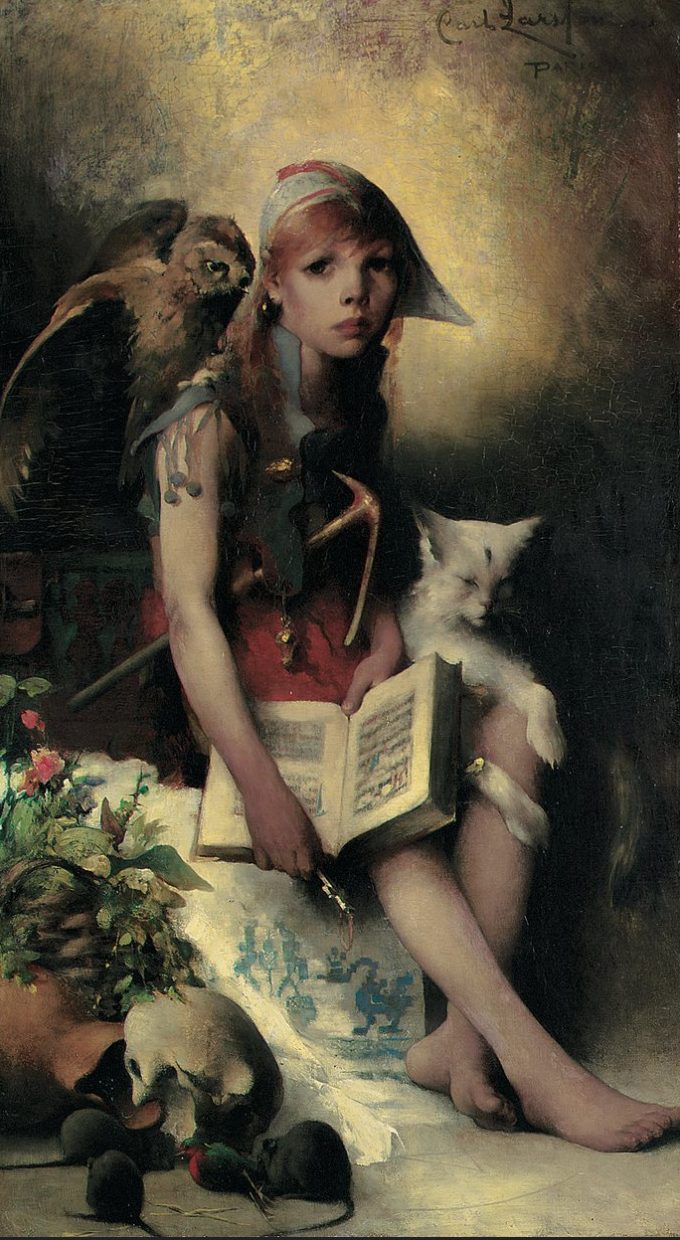
Ever since Carl Larsson’s painting, “The Witch’s Daughter” (1886) appeared in my Twitter feed a couple of years ago, it has lingered in my mind as a subject matter of perpetual intrigue. To my disappointment, due to the sparsity of literature available online, it would appear this painting is a lesser renowned work by the Swedish painter, known primarily for his warm depictions of domestic life in Sweden. While much of Larsson’s oeuvre focuses on idyllic family scenes and his home at Lilla Hyttnäs in Sundborn, “The Witch’s Daughter” diverges into more fantastical, even dark territory, hinting at the artist’s ability to explore themes beyond his wholesome artistic aesthetic.
Background
Carl Larsson (1853–1919) is one of Sweden’s most prominent artists, particularly famous for his depictions of contemporary domestic life. His works are characterised by their delicate balance of gentle colour, intricate detail, and composition; often capturing the simplicity and beauty of Swedish rural life. However, through “The Witch’s Daughter”, Larsson’s artistic range evidently extends beyond these aesthetically idyllic scenes to matters of dark mythology, folklore and the supernatural; thus simultaneously alluding the contemporary Romanticism and Symbolist traditions in the late 19th and early 20th century.
Mood & Tone
In Scandinavian folklore, witches were often feared figures, associated with dark magic and nature’s mysteries. A “witch’s daughter” implies a lineage of witchcraft or otherworldly power, thus the painting could be seen as an exploration of what it means to inherit such a legacy. Larsson’s portrayal of the “witch’s daughter” is enigmatic. Despite his subject bearing a pensive expression, her posture evokes a sense of burden. Her body faces the left yet she gazes to the right, making eye contact with the viewer, perhaps inviting them to speculate on the sense of otherness and the burden of mystical ancestry which she bears. In turn, with his subject matter’s direct gaze, Larsson bridges the gap between what European folklore would consider to be outcast with the contemporary viewer – the ‘witch’s daughter’ invites the viewer to share in the burden of darkness; ‘otherness’, which weighs heavily upon her. Moreover, Larsson’s choice to focus on the witch’s daughter rather than the witch herself could allude to a generational tension or the idea of legacy – how must it feel to inherit something like magical power or witchcraft?
Symbolism – The Witch Figure in Art
The daughter’s emotions or state of mind is unclear – is she proud of her lineage, or is she burdened by it? This ambiguity invites viewers to infer multiple interpretations, adding to its allure. The symbolism of the ‘witch’ in artwork is multifaceted, appearing in art for centuries, symbolising everything from female power and independence to fear of the unknown. In the late 19th century, witches were often romanticised, depicted as tragic or misunderstood as opposed to sinister. “The Witch’s Daughter” may touch on this theme, presenting the young woman as someone caught between worlds – neither fully part of the supernatural nor the everyday. Moreover, if we take this interpretation and delve deeper into the role of the daughter, Larsson could be depicting a thematic exploration of innocence versus corruption, youth versus maturity, or magic versus the mundane. Thus, the painting offers a counterpoint to Larsson’s idealised depictions of family life, presenting a more complex vision of identity, inheritance, and nature.
To summarise…
“The Witch’s Daughter” by Carl Larsson is a haunting and lesser-known example of the artist’s range yet bears significance in demonstrating his artistic and thematic versatility. The painting, steeped in folklore and myth, reveals Larsson’s capacity to move beyond his familiar domestic scenes into more mysterious and symbolically rich territory. By focusing on a witch’s daughter, Larsson invites us to explore themes of inheritance, power, and otherness in a uniquely poetic and haunting way. He places the viewer in a sense of discomfort amongst imagery of death, decay and witchcraft, challenging them to consider the role of ‘the witch’ in folklore and its association with femininity; both female power and female innocence.

 Logan Darkwoods